Verity
On-chain supply chain finance for Capital Due Value
Verity turns invoice claims into accounting-valid obligations, then coordinates factoring, USDC escrow, settlement, and payment profile evidence across suppliers, buyers, and investors.
Product principle
Make Capital Due Value is financeable.Supplier
Buyer
Investor
Escrow
VALUE RESOLUTION LAYER
The platform resolves commercial value before it releases finance.
Accounting truth
PO, delivery, invoice, acceptance, and payment are distinct states.
Risk control
Duplicate prevention and buyer acceptance block financing of weak claims.
Programmable settlement
USDC escrow distributes principal, yield, fees, and residual balances.
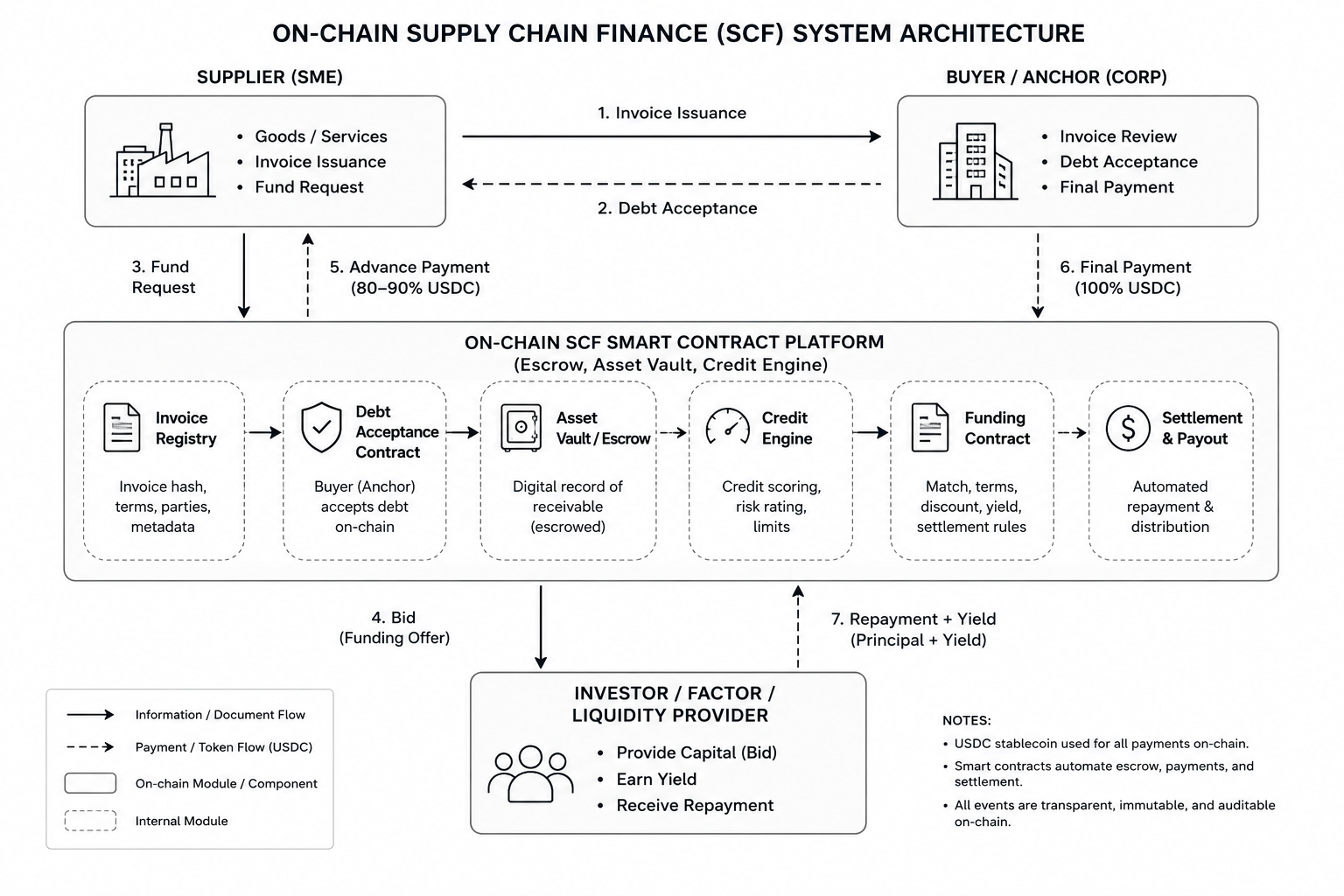
SYSTEM VISUALIZATION
Architecture connects invoice truth, wallet funding, and settlement execution.
Invoice Origin
Maturity Debtor
Liquidity Provider
SYSTEM VISUALIZATION (STATIC REFERENCE)
Architecture connects invoice truth, wallet funding, and settlement execution.
OPERATING WORKFLOW
Three user surfaces converge on one accepted receivable marketplace.
Supplier / SME
Buyer / Enterprise
Investor / Factor
Control point Accepted value is separated from face value, making the financed asset auditable.
ROADMAP
MVP delivery proves the full Due Value-to-settlement loop.
Align
schemas, roles, state machine
Invoice truth
supplier issue + buyer acceptance
Marketplace
factoring request + investor funding
Escrow
advance, retention, maturity settlement
Risk
delinquency + payment profile evidence
Demo
end-to-end validation and polish
End-to-end demo must show accepted Due Value financed, advanced, repaid, and reconciled.
Ideation -> Use Cases -> MVP Roadmap, with UC-001 through UC-014 validating the product thesis.
AI RISK ANALYSIS / WHY NOW
AI should accelerate risk judgment, not replace Verity's acceptance and policy controls.
Use AI as a decision-support layer across invoice submission, buyer validation, funding eligibility, allocation, and settlement monitoring.
Static checks struggle with emerging buyer stress, low-grade dispute patterns, invoice manipulation signals, and portfolio drift that only becomes visible over time.
Faster credit decisions, earlier loss prevention, stronger investor confidence, and a smaller manual-review burden for risk operations.
Fraud risk
Detect near-duplicate invoices, semantic document mismatches, abnormal tenor shifts, and suspicious submission cadence earlier.
Credit risk
Score probability of delay or default using repayment timing, dispute history, and concentration across buyer obligations.
Operational risk
Surface supplier reliability issues from correction frequency, completeness gaps, and recurring workflow exceptions.
Portfolio risk
Track exposure drift across buyers, sectors, geographies, and funded assets before deterioration shows up in realized losses.
AI RISK ANALYSIS / WORKFLOW FIT
Each workflow state gets an explainable AI output that improves prioritization, pricing, and monitoring.
1. Submission
Score document completeness, invoice-to-PO semantic fit, abnormal value or tenor, and suspicious supplier behavior.
2. Buyer review
Prioritize high-risk invoices, suggest hold reasons, and estimate dispute likelihood before acceptance becomes financeable.
3. Funding eligibility
Generate composite credit score, delay probability, expected loss, and pricing or advance-rate guidance.
Translate model outputs into investor-safe narratives like low-risk anchor receivable, operationally volatile, or high-yield high-dispute exposure.
Continuously assign watchlists, trigger early warning alerts, and queue collections or operations attention before maturity is missed.
AI RISK ANALYSIS / OPERATING MODEL
The rollout should stay hybrid: deterministic controls first, explainable models second, human approval for material decisions.
Hard controls
Policy gates, eligibility rules, duplicate prevention, and acceptance states remain deterministic and auditable.
Model layer
Prediction and anomaly models enrich buyer risk, supplier reliability, invoice fraud, and portfolio deterioration signals.
Explainability
Every score should return reason codes, risk banding, and supporting factors that investors and operators can review.
Rollout path
Start with advisory scoring, then controlled underwriting assistance, then portfolio-level early warning as data quality matures.